The fastest way to bring a rendering plant into 2026 compliance is to combine source containment with a multi-stage treatment train — typically a wet scrutiny scrubber for high-concentration cooker vents, followed by a biofilter or biotrickling filter to polish process air. No single technology handles every odor stream. Plants that try to bolt on one box and call it done almost always fail their next inspection.
Below are the five methods that actually work in 2026, with realistic performance numbers, when to use each, and what most operators get wrong.
Why Odor Compliance Got Harder in 2026
Most regulators have shifted from concentration-based limits (ppm of H2S) to nuisance-based and odor-unit standards measured at the property line. That changes everything. You can be well under your hydrogen sulfide ppm cap and still get fined because a neighbor complained and a dynamic olfactometry test confirmed exceedance.
The EU’s revised IED guidance, the US EPA’s tightened Title V monitoring, and China’s GB 14554 odor pollutant standard all converged around the same idea: prove your plant doesn’t smell at the fenceline. For rendering operations — where amines, mercaptans, aldehydes, and trimethylamine dominate — that’s a tall order.
The plants thriving under the new rules share one habit: they treat odor as a process design problem, not an end-of-pipe afterthought.
Rendering Plant Equipmentchengzhu Small unit
Method 1: Source Containment — The Cheapest Compliance Win
Before you spend a dollar on treatment equipment, ask: is the odor even escaping in the first place? Most rendering plants leak at the same five spots — receiving bays, raw material bins, cooker vents, conveyor transfers, and meal cooling.
Negative pressure enclosures around the receiving pit and raw material handling area cut total emissions by 40–60% on their own. A sealed raw material bin with a vapor capture hood, paired with an enclosed horizontal belt conveyor system, can eliminate the worst fugitive emissions before they ever reach the atmosphere.
For instance, a mid-sized poultry rendering plant in Shandong reduced its fenceline odor complaints from 14 per month to zero after sealing its receiving area and routing all transfer points through a single suction header to its existing scrubber. Total cost: less than the price of a new RTO.
What to seal first
Truck unloading bays — install fast-closing doors and a misting curtain
Raw material bins — closed-top with vapor suction
Cooker manhole covers and inspection ports — gasket replacement schedule
Screw conveyor flanges — the #1 source of “mystery smell”
Method 2: Wet Scrubbers — Front-Line Defense for Cooker Vents
The hottest, smelliest air in any rendering plant comes from the cookers — saturated with steam, ammonia, trimethylamine, and short-chain fatty acids. Send that directly to a biofilter and you’ll kill the microbes within a week.
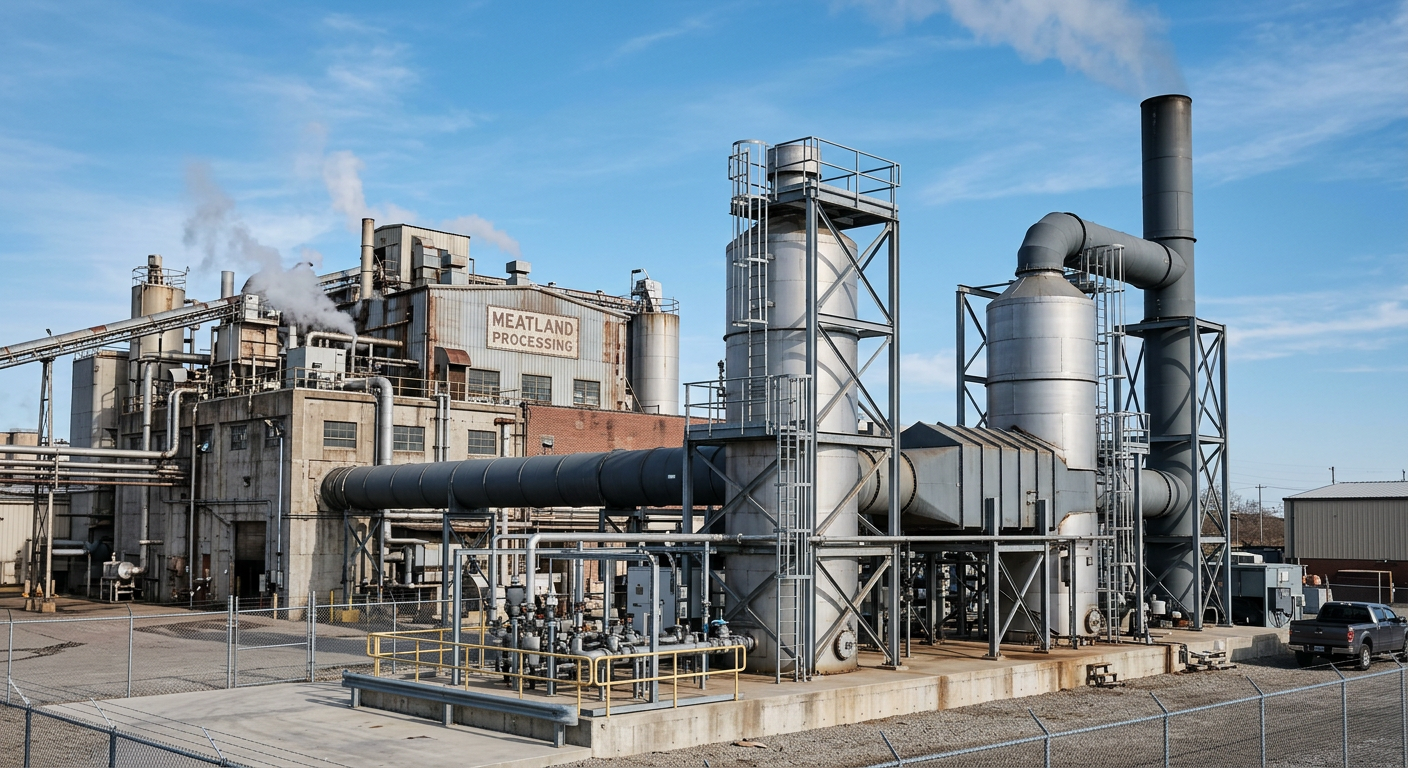
A two-stage wet scrubber handles this. Stage one uses an acidic scrub (sulfuric acid at pH 2–3) to capture amines and ammonia. Stage two uses an alkaline-oxidative scrub (NaOH plus sodium hypochlorite at pH 9–10) to knock down sulfides and mercaptans. Together they hit 70–90% removal and cool the gas to a workable 35–40°C.
Critical detail most operators miss: residence time. Below 1.5 seconds of contact in the packed bed and removal efficiency collapses. Size the column for your worst-case flow, not your average.
Pair scrubbers with a properly engineered paddle dryer system where vapor is captured at source — the combination reduces downstream loading by 50% or more.
Method 3: Biofilters — The Workhorse for Polishing
After scrubbing, you still have low-concentration, high-volume air that contains the trace compounds your nose (and the olfactometer) hates most. This is where biofilters earn their keep.
A modern biofilter uses a 1–1.5 meter deep bed of wood chips, compost, or engineered media inoculated with specific bacterial consortia. Air passes through at 60–180 seconds residence time. Microbes do the work — for free — once the bed is established.
Real performance numbers
H2S removal: 95–99% at inlet concentrations under 50 ppm
Ammonia removal: 80–95%
Total odor unit reduction: 90–97%
Operating cost: roughly $0.05–0.15 per 1,000 m³ treated
The catch? Biofilters need babying. Moisture has to stay between 50–65%, pH between 6.5 and 8, and temperature ideally between 20–40°C. Let the bed dry out for 48 hours and you’re rebuilding the microbiome for the next month.
For plants wanting a more controlled biological approach, an odor digestion treatment system integrates the moisture, nutrient, and pH controls into one skid — removing most of the manual maintenance.
Two-stage wet scrubber column for rendering plant cooker vent treatment
Method 4: Regenerative Thermal Oxidizers (RTOs) for High-Load Streams
When you’ve got concentrated VOC streams — think blood processing, feather hydrolysis, or batch cooker vent gas after primary scrubbing — biological treatment can’t keep up. That’s RTO territory.
An RTO destroys odor compounds by combusting them at 800–850°C. Thermal efficiency tops 95% thanks to ceramic heat exchanger beds that recover combustion heat. Destruction efficiency runs 98–99% across virtually every reduced sulfur and nitrogen compound rendering plants produce.
The downside is operating cost. Natural gas is the dominant variable. Below ~2 g/Nm³ of VOC loading, you’re paying for auxiliary fuel. Above that, the unit becomes autothermal and runs on the odor itself — which is the dream scenario.
Smart plants size RTOs to handle only the concentrated streams: pre-scrubbed cooker vent, blood dryer exhaust, and the heaviest feather meal processing air. Diluting these with general plant ventilation kills your fuel economics.
Method 5: Activated Carbon — The Polishing Step Nobody Talks About
Activated carbon isn’t sexy, but it’s often the difference between “passes most days” and “passes every day.” Use it after biofilters or scrubbers as a final guard — especially for upset conditions when biology lags behind a sudden load spike.
Coconut-shell-based carbon with KOH or KI impregnation handles H2S and mercaptans at 0.3–0.5 kg of contaminant per kg of carbon before saturation. That’s enough for 6–18 months of polishing duty in most rendering applications.
The trick: continuous outlet monitoring. Carbon beds give no visual indication when they break through. Install a fenceline H2S sensor logging every 5 minutes and you’ll get 1–2 weeks warning before the bed exhausts. Get caught without monitoring, and you’ll find out when the inspector arrives.
Putting It All Together: A Realistic Treatment Train
No serious rendering plant relies on a single technology. Here’s what an effective 2026 stack actually looks like for a 200 ton/day operation:
Source containment — sealed receiving, enclosed conveyors, negative pressure throughout
Stream segregation — high-load cooker/dryer vapors separated from general ventilation
Acid + alkaline scrubber on the concentrated stream (70–90% removal)
Biofilter or biotrickling filter on combined post-scrubber + general ventilation (additional 90%+ removal)
Activated carbon polish on the biofilter outlet for upset protection
Continuous fenceline monitoring — H2S, NH3, and quarterly olfactometry
Total stacked efficiency: 99%+ on H2S, 95%+ on total odor units. That’s what a passing inspection looks like.
If you’re modernizing existing equipment, integrating odor control with broader rendering plant process optimization usually pays back faster than retrofitting treatment alone — better cookers and dryers produce less odor at source.
Open biofilter bed treating rendering plant exhaust air
The Three Mistakes That Sink Most Odor Projects
After working with hundreds of rendering operations, the same expensive errors repeat:
1. Oversizing one stage, undersizing another
A massive RTO downstream of a weak scrubber wastes fuel. A premium biofilter behind unsealed receiving never reaches design efficiency. Balance matters more than peak capacity in any one unit.
2. Ignoring upset conditions
Compliance is measured on your worst day, not your average. Design treatment for 1.5× peak load, install bypass-monitored polishing carbon, and run quarterly olfactometry — not just stack tests.
3. Treating odor as separate from production
Better source control beats bigger treatment. A modern animal waste rendering plant designed with sealed processing from receiving to meal bagging cuts odor load by 60% before treatment even begins. That changes the size — and cost — of everything downstream.
Bringing Your Plant Into 2026 Compliance
The plants passing odor inspections today share one trait: they engineered odor out of the process before they bought equipment to clean up what was left. Source containment, segregated streams, multi-stage treatment, and continuous monitoring — together, they make the difference between a plant that operates freely and one that runs on borrowed time.
If you’re planning an odor control upgrade, retrofitting an aging facility, or designing a new line, chengzhurendering can help size and integrate the full treatment train — from sealed receiving bins to biological digestion systems — drawing on 80+ patents and 17 years of rendering plant engineering experience. Reach out and we’ll review your fenceline data and current setup, then map out the most cost-effective path to compliance.
Industrial RTO unit for rendering plant VOC destruction


 Blog · 9 月 04, 2026 CIP Cleaning for Rendering Equipment: Hygienic Design, Cleaning Sequence, and Downtime Planning Read More


宠物食品有限公司-21-768x576.jpg)